

The Haitian judge who signed an arrest warrant for President Jovenel Moïse that figured prominently in the late leader’s July 7, 2021, assassination testified Friday that the document was illegal and that he had no authority to remove a sitting head of state. Jean Roger Noelcius also admitted under oath during a deposition in Miami federal court that neither private nor foreign individuals can execute arrest warrants in Haiti, which is the purview of the Haitian national police.
Read more at: https://www.miamiherald.com/news/nation-world/world/americas/haiti/article314783294.html#storylink=cpy
The dubious 2019 warrant was used as a pretext to arrest Moïse and remove him from power in two attempts: a foiled coup on Feb. 7, 2021, and the assassination on July 7, 2021. Suspects arrested in the assassination have repeatedly cited the warrant — and a letter sent to the U.S. ambassador at the time, Michele Sison, acknowledging its existence — as the reason for their involvement in Haiti: to arrest, and not kill the president, amid the ongoing debate over the timing of the end of his official presidential mandate. Opponents of the president had claimed his term ended on Feb. 7, 2021, while U.S. authorities insisted his term ended Feb. 7, 2022. Noelcius was an investigative magistrate in Haiti, a powerful post from which judges carry out investigations and, based on findings, issue indictments and warrants for the arrest of individuals. Sometime in January 2021 — weeks before the foiled presidential coup and six months before a group of hired Colombian commandos and two Haitian Americans posing as U.S. Drug Enforcement Administration agents descended on Moïse’s home claiming to be executing the arrest warrant — Noelcius signed the document, added an official seal and backdated it to Feb. 18, 2019, accusing the Haitian president of “assassination.” READ MORE: Who was involved in killing of Haiti president Jovenel Moïse He testified about the events leading up to his involvement in the high-profile case during six hours of questioning conducted by video from Canada, where he fled five months before the killing. While conceding that he had signed the warrant, he rejected any suggestion that he bore responsibility for Moïse’s killing.
Read more at: https://www.miamiherald.com/news/nation-world/world/americas/haiti/article314783294.html#storylink=cpy
The assassination led to a political vacuum and plunged Haiti deeper into chaos, with armed gangs running amok. The country now finds itself with no elected president or parliament, and one of the world’s worst humanitarian crisis. “I have nothing to do with this situation,” Noelcius said in Haitian Creole, speaking through a translator, later admitting he knew he had no authority to be “signing a warrant against a sitting president.” Noelcius’ deposition came two weeks before the scheduled March 9 trial of five men from South Florida and Haiti who are charged with a conspiracy to assassinate Moïse at his home in the hills outside Port-au-Prince more than four years ago. Six other defendants charged in the high-profile case have already pleaded guilty to the conspiracy or related charges. A parallel case in Haiti has been reopened and assigned a new investigative judge after the country’s appeals court overturned indictments. The Haitian court cited procedural irregularities and a failure to identify the killing’s mastermind in its decision. Motivation for warrant Noelcius’ motivation for issuing the arrest warrant for the president has been a key question for Moïse’s family. Its answer remained a mystery Friday as he feigned a lack of understanding to some of the questions posed by defense lawyers and a federal prosecutor, pushed back on questions he deemed political and insisted that he too is “a victim in this situation.” He pointed the finger at a lawyer and former Haitian government prosecutor named Mario Beauvoir. Beauvoir, who Noelcius claimed was in touch with the U.S. Embassy in Port-au-Prince, said he wanted Noelcius to save the country by issuing the warrant, the former magistrate testified. He was taken to meet Beauvoir, he said, by his courtroom bailiff, whose name, under questioning from defense attorney Humberto Dominguez, he claimed he could not remember. “He played me to put me in that predicament,” Noelcius said of Beauvoir, insisting it wasn’t until the foiled plot to arrest Moïse unfolded in February 2021 with a predawn raid led by presidential palace guards that he started to realize he had been duped.
Read more at: https://www.miamiherald.com/news/nation-world/world/americas/haiti/article314783294.html#storylink=cpy
The 19 Colombian mercenaries charged in the assassination — and the Miami-based security contractor who hired them — have said they were accompanying Haitian national police officers to execute Noelcius’ arrest warrant when Moïse was shot inside his bedroom at his home in the hills of Petion-Ville. A crumpled copy of the arrest was later found in one of the homes occupied by some of the suspects.
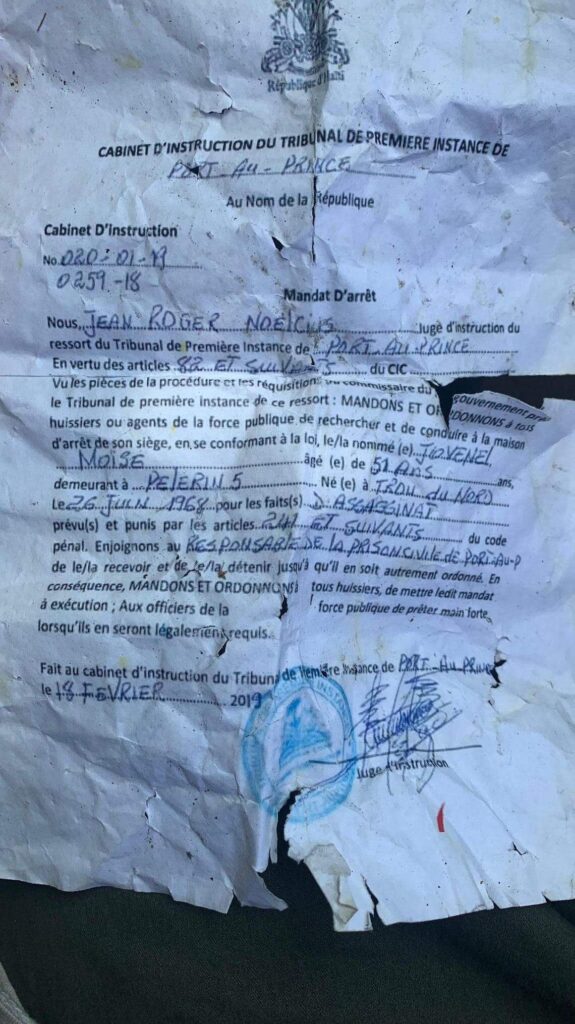
The pretext for the “arrest” of Haiti President Jovenel Moïse is a dubious 2019 arrest arrest warrant issued against Moïse “for assassination” by Investigative Judge Jean Roger Noelcius. A crumbled copy the warrant was found in one of the homes occupied by some of the suspects in Port-au-Prince. Miami On Friday, Antonio Intriago, the owner of the firm that hired the gunmen, South Florida-based CTU Security, and four others charged in the killing sat in the Miami courtroom as a federal prosecutor and defense lawyers questioned Noelcius about the origins and purpose of the warrant.
As the long-awaited trial looms, defense attorneys have zeroed in on the role of U.S. authorities and what they may have known about the assassination before it happened. U.S. authorities have repeatedly said they had no involvement in the plot.
During the questioning, government prosecutor Jason Wu asked Noelcius if the warrant authorized anyone to kill the president, capture and take him out of the country or give foreigners the right to take it from the internet to execute it. Though defense lawyers objected to the line of questioning, Noelcius answered “No” to each query.
Much of the questioning centered on the weeks leading up to Feb. 7, 2021, the day Moïse announced there had been a foiled “coup” and “assassination” attempt against him. Moïse mentioned the arrest warrant and his search for the judge who had signed it, Noelcius said.
“The warrant already had no value once the president denounced it,” he said. “There was no way to execute it.”
Amid calls for Moïse’s ouster, Haiti announces arrest of 23 people in alleged coup attempt Noelcius acknowledged that the issuance of the warrant did not follow normal procedures, which would involve an investigation and the participation of the dean of the courts.
“I was in a very difficult situation,” he said, claiming he was under duress by Beauvoir to provide the document. “That’s the document Mario had me write,” Noelcius said, referring to the warrant, which prosecutors entered into evidence. “From what he stated at the time, it was at the request of the U.S. ambassador and I would not suffer any repercussions.”
The request The initial request, he testified, took place in “a big space behind the U.S. embassy,” where he said Beauvoir told him he would be put in contact with “the American ambassador because Moïse wanted to resign.” “They needed an arrest warrant,” Noelcius said he was told. The document, he added, would be “symbolic” and kept in a safe at the embassy.
Beauvoir then took his phone, made a call and said, “The judge is here,” before handing it over, Noelcius testified. The person on the other end was a man whose Creole, he said, “wasn’t so correct.” The caller explained the need for the warrant and promised there would be no repercussions for his family. Noelcius acknowledged that he never confirmed he was speaking to the U.S. ambassador, who was a woman. He said he agreed to issue the document only after Beauvoir later contacted him and said, “Judge, I received an order to protect you.” He testified that he was told to leave his home and relocate for security reasons. “When he said I could no longer stay at my house, I knew I was in danger,” Noelcius said.
Reached by telephone, Beauvoir told the Miami Herald he would not comment, adding only that he is a lawyer. He has figured prominently in both the Feb. 7 episode and the July 7 assassination, in which suspects used fabricated claims about State Department investigations and a DEA operation as cover to gain access to the president’s residence. At times during questioning by defense lawyers, Noelcius was evasive, declining to answer questions about his views of the president in early 2021.
He said he did not know prominent political figures, such as former Haitian senator John Joel Joseph, who has pleaded guilty in the case, and did not know how many judges sat on Haiti’s Superior Court. He acknowledged that the warrant was not issued “during a normal procedure,” but said he did not believe he faced criminal exposure back in Haiti. Still, he testified that his efforts to obtain legal status in Canada have been “blocked” for security reasons.
After signing the warrant, Noelcius said, he was taken to Petit-Bois, an apartment complex where several Haitians — including a superior court justice — were later arrested in connection with the February plot during the predawn raid. As news of the Feb. 7 raid and arrests spread, and he saw a copy of his signed arrest warrant circulating on social media, Noelcius said he grew fearful and fainted. The next day, he fled to his sister’s home. ‘They used me like a puppet’ In a final conversation with Beauvoir where he was crying, Noelcius said the lawyer told him, “Judge, you don’t need to cry. What you just did is going to save the country.” “They used me like a puppet,” he said.
“They wanted to use me under the guise of saving the country.” On Feb. 11, he crossed into the Dominican Republic. Five days later, Noelcius traveled to the United States and arrived in Canada on Feb. 28, where he now works as a factory clerk at night while attending classes in the morning and taking care of his minor daughter. “Today, my career as a judge has been destroyed.”
Miami Herald reporter Jay Weaver contributed to this report.